Sunday, March 20, 2011

How to eat a croissant

People might think that since I live in Paris, I would be and should be eating croissants everyday. Wrong. I prefer the escargot (a rolled danish pastry usually with raisins) or the pain aux noix (walnut bread). I was reading David Lebovitz's blog the other day and if the sesame or cereal baguette was crack to him, these two breads are for me.

But on the occasion that I do eat croissants, I like to dress them up. 
Melted Comte, slice of prosciutto, poached egg, salt & pepper.


Honestly, this is one awesome combination. The layers of croissant pastry would soak up the runny egg yolk and the saltiness of the prosciutto and cheese flavors it. It also comes in pretty handy when you have guests or friends over in the morning. Parisians don't eat a lot for breakfast so it's difficult to find fried eggs and bacon around town at a reasonable price. This, you can whip up easily at home, at a friendly budget and impress your friends in the process. Otherwise, it's a good way to treat yourself and savour the beauty of a croissant.


How to Poach an Egg

  1. You'll need a frying pan that is quite deep. Fill it with enough water to cover an egg (about 2/3) and bring it to a simmering boil. It's when you can see bubbles on the base of the pan and some small ones are escaping to the surface. If the water's gone to a boil, don't worry. Lower the heat to bring it to a simmer. Meanwhile, crack an egg into a small bowl.
  2. When the water has reached a simmer, use a whisk and create a whirlpool.
  3. Quickly but gently (be as close to the surface of the water as possible), slide in the egg.
  4. For runny yolks, leave it to cook for 3 minutes. You can also use a wooden spoon to gently fold the edges of the egg whites over the egg. This makes the egg come out neater. 
  5. Take out using a slotted spoon and serve immediately :)

Wednesday, March 16, 2011

Honey


I didn't expect buying honey in the supermarket would be confusing.


There was honey in liquid form and there was honey that looked like...paste (okay, I must be the most clueless person around to be surprised that it's raw honey). Then there was honey in pale yellow, gold, brown and deep brown. The description didn't help either. Honey with orange, honey from flowers, mountain honey, natural, bio and honey from France, Spain and this other country I didn't know the translation for.

I guess I should be thankful to have a variety of choice. But what's the difference in taste? Honestly, I have not a clue. In the end, I just chose whichever looked the most familiar and 'reliable' to me. One thing I know, though, is that honey is delicious in both savory and sweet dishes. 


Remember cafe Le Loire from my previous post? When I went there, I also tried their emmenthal quiche with honey and pine nuts. It's been resonating in my mind ever since. Who would have thought of mixing cheese and honey? Yum! It's one of the best and most surprising combinations I've come across while in France (The first encounter was a baked camembert cheese drizzled with honey. That was amazing too!)


Honey and desserts are, of course, no strange territory. So is a honey pound cake. I found and adapted the recipe from Joy the Baker. A sweet finish to a sweet start.

Emmenthal Quiche
with honey & pine nuts
makes a 22cm tart 

Traditionally, a quiche egg mixture is fully cream with eggs, but mindful of my waistline, I've decided to sub 1/3 with milk. You can do half and half.

Ingredients
250g shortcrust pastry dough (pâte brisée)
3 eggs
200ml double cream
100ml milk
salt, pepper, nutmeg
1 cup grated emmenthal cheese
honey, for drizzle
pine nuts, toasted, for garnish


Method
  1. Preheat oven to 180C.
  2. Roll out the pâte brisée and line a 22cm tart ring/pan.
  3. Prick with base with a fork and blind bake until light golden brown.
  4. While the shell is baking, whisk the eggs and cream in a medium bowl.
  5. Season to taste.
  6. Add 1/2 of the grated cheese to the mixture.
  7. After the shell is partially cooked, sprinkle 1/2 of the remaining cheese on the base of the tart.
  8. Fill the shell to the brim with the mixture.
  9. Sprinkle the remaining cheese on top.
  10. Bake in the oven for 45 minutes or until the top is golden. (I read in a blog that it's good if the quiche is still jiggly but a knife inserted into 2.5cm from the edge comes out clean. If one tests the center, it would be too dry).
  11. Leave to cool in a wire rack.
  12. To serve, drizzle honey and several pine nuts on the individual slices.

Honey Pound Cake
makes 1 loaf
adapted from here

Ingredients
1 1/4 cup all-purpose flour
1 cup buckwheat flour
2 tsp baking powder
3/4 tsp salt
a pinch of cinnamon, nutmeg and all-spice
190g unsalted butter, room temperature
2/3 cup sugar
1/2 cup honey
3 eggs,
1 cup milk
100g walnuts, chopped finely (optional)

Method
  1. Preheat the oven to 180C.
  2. Butter and flour a loaf pan.
  3. Whisk the flours, baking powder, salt and spices together in a medium bowl. Set aside.
  4. In another medium bowl, beat the butter, sugar and honey until light and fluffy, about 3-4 minutes.
  5. Beat in the eggs one by one, beating well after each addition.
  6. Fold in the dry ingredients in 3 additions and alternate with the milk.
  7. Fold in the chopped walnuts.
  8. Pour the batter into the loaf pan and smoothen the top.
  9. Bake for 1 hour or until a knife inserted into the center comes out clean (I had to bake it for another 10 minutes).
  10. Remove from oven and leave to rest for 30 minutes before unmolding and cooling it on a wire rack.
Whatever you do, don't start slicing the bread until it's cooled. Or if you must do so, do it carefully. Loaf cakes are fragile when still hot and at school the chef actually said quickbreads are better after a week. I'm not sure about a week...but the honey loaf sure tastes better after a day.


Monday, February 14, 2011

Pâte sablée


In French pastry, the short-crust dough can mean a lot of things. 
It can be the pâte à foncer (or brisée), the pâte sucrée or the pâte sablée

What's the difference among them all? The point at which the butter is added and the ingredients.

The pâte à foncer is the most basic of them. It's made by cutting the butter into the flour and it does not use any sugar or baking powder. It's the shortcrust dough for savory tarts and some sweet tarts like the classic tarte aux pommes.
The Pâte Sucrée contains icing sugar and is made by creaming the sugar and the butter first before adding them to the dry ingredients. The result is a base that's firmer (less crumbly) than the pâte à foncer. It's used for dessert tarts, from the classic French pear tart, to the lemon or chocolate tart.
photo.php.jpg
Pâte sablée, is a variation of the pâte à foncer. It's made in the same method by cutting butter into the dry ingredients but it has the addition of icing sugar and baking powder. It's the most crumbly of all the doughs and, in fact, it is the dough for shortbread biscuits.

The similarity? The mixing of the dough. The aim of any tart-making process should be to prevent elasticity and developing gluten in the tart. In other words, to handle or knead the dough in the least amount possible. Why? Because gluten will make the tart hard as cardboard and coarse as sandpaper. The tart base should have visible layers of dough. The method they taught us in school is strange but it does the trick. 


Pâte sablée

Ingredients
250g all-purpose flour
5g baking powder
125g icing sugar
125g cold unsalted butter, cut into cubes
1 egg

Method
  1. Sift together the flour, baking powder and icing sugar onto a work surface
  2. Add the butter cubes and using your fingertips, rub them into the flour until no large pieces remain (pea-sized butter pieces are fine).
  3. Scoop up the flour and rub them between your palms, around 6-8 times, until the mixture resemble breadcrumbs.
  4. Make a well in the middle of the mixture and crack the egg in it.
  5. Break the yolk and slowly mix it into the mixture until it forms a dough. Don't knead. If there are dry pieces of flour, take the formed dough in your hand and 'dab' it onto the dry pieces.
  6. Gather the dough into a rectangle, and using a metal scraper, cut a small part of the dough and push it down onto the work surface with the blade. Do this 3-4 times on the same piece of dough. It should look curled in the end.

   7. Do this to the rest of the dough and gather the curls in a cling wrap.

   8. Pat to flatten and refrigerate until needed.

A pie and the foolproof way to make caramel sauce

One other flavor that can rival chocolate in its sweet, velvety and comforting goodness is most probably caramel. In the past, I tended to overlook this ingredient. It was too sweet, too sticky and plain difficult (i.e. scary!) to make. The first time I made caramel, it burnt. The second time, it was way undercooked. After that, I stayed away.

However, the past week had given me a fresh perspective.

I had just completed the second week of pastry internship and the major task was to make caramel. Caramel ice cream, soft caramel candies and caramel ganaches for chocolate bonbons. I had no choice but to face my fear. Thank goodness for my leader. He showed me some tips on how to avoid caramel disasters and most important of all, the color to pour in the cream. Seeing the whole process put caramel in a new light for me. It is tricky, but it is amazing how something as simple as sugar can be transformed to taste, smell, look and feel differently. Not forgetting, the best partner of caramel is the salted butter.


paris-le-loir-dans-la-theiere.jpg
Then there was the cafe. At first glance, Le Loir dans la Théière's maroon walls and dim-lighted interior don't stand out much. Look further, and it's one of those rare places in Paris with armchairs, wall-posters and a not-trying-too-hard ambience that you can sit in all day. They have a long table filled with the desserts of the day. Homey desserts. There is always a tall, bursting lemon meringue pie (their specialty), a crumbly chocolate tart, big slices of almond cake and a towering, long millefeuille. Last monday, they had Banoffee.
The banoffee came in a rectangular slice: the top two thirds was whipped cream, then a layer of banana slices in a brown sauce (coffee came to my mind) and finally a biscuit. The first bite confirmed that the filling were bananas in caramel and the base a crispy, crumble-like tart dough. The caramel was the ingredient that brought all the elements together.

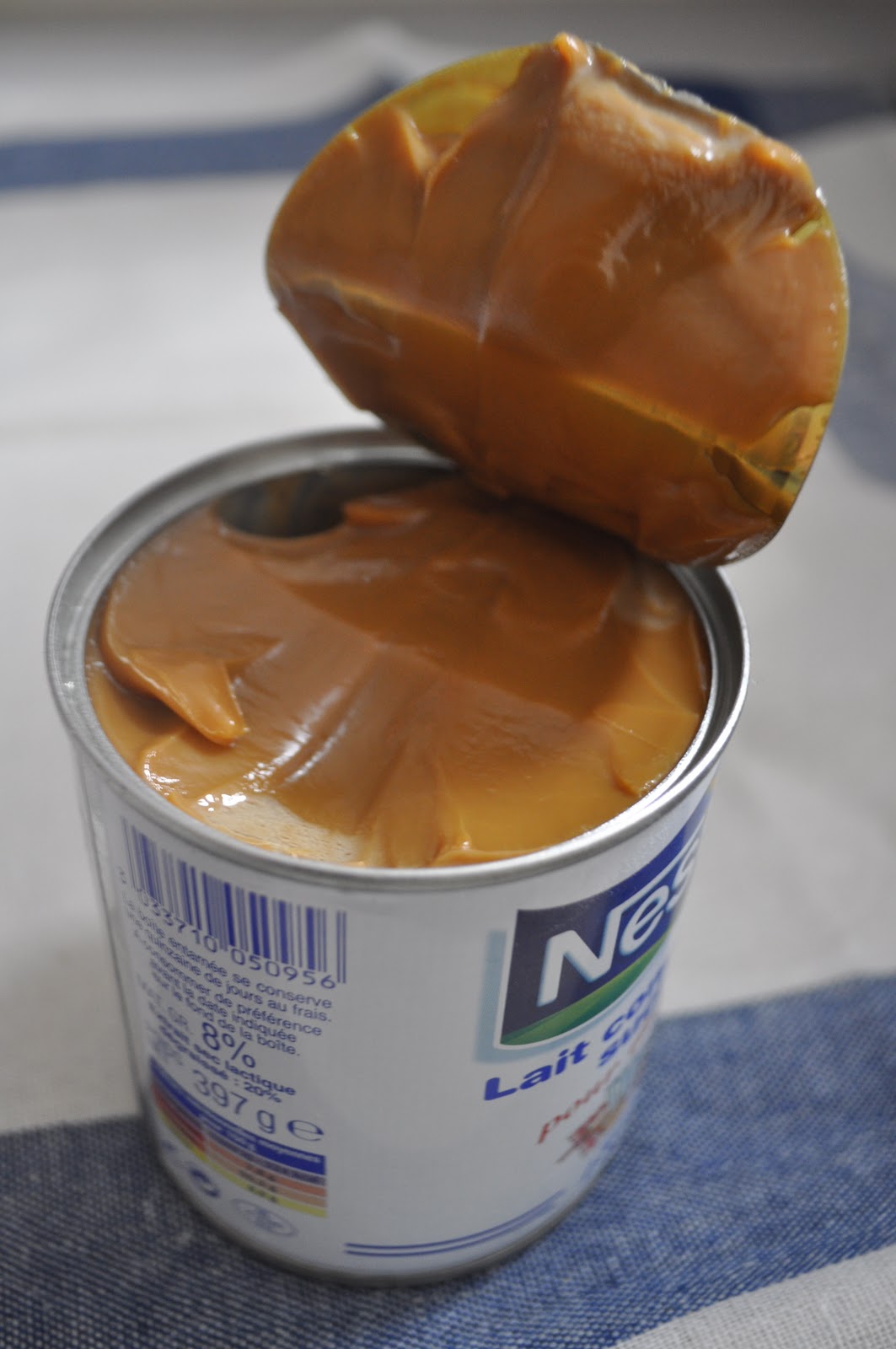
I couldn't stop thinking about the Banoffee after my caramel week. I googled the recipe and strangely enough, the original dessert (from Britain) doesn't even use real caramel! The recipes said to boil an unopened can of condensed milk for 3 hours. I couldn't believe it at first, but now...
Yes, the color did change. The result is not as nutty or fragrant as the real deal but it still tastes great for this pie. Best of all, it's easy to make. Guaranteed. Just make sure that you cover the can fully with water at all times. Otherwise it might explode.


Banoffee
makes a 22cm tart
adapted from here


Ingredients
250g Pate Sablée or any other shortcrust pastry dough
1 can (375g) condensed milk
3 large bananas, sliced
300ml whipping cream
3 tbsp mascarpone cheese
1/2 tsp instant coffee
1 tsp caster sugar
vanilla extract
cocoa powder, for garnish


Method
  1. Immerse the unopened can of condensed milk in water and boil it for 3 hours. Check every 15-20 minutes to ensure there is enough water to fully cover the can. Add more if necessary.
  2. Preheat oven to 190C.
  3. Butter and line a 22 cm tart pan with shortcrust dough
  4. Bake the tart shell filled with weights for 25 minutes. After, take out the weights and bake for a further 8 minutes or until golden brown.
  5. Cool the tart shell and the can.
  6. Fill the tart shell with the caramel filling.
  7. Layer with the banana slices.
  8. In a medium bowl, whip the cream until soft peaks.
  9. In a separate, smaller bowl, mix the mascarpone cheese, instant coffee, sugar and extract until the cheese is soft and the coffee granules well dissolved.
  10. Add the cheese mixture to the cream and whisk until well combined.
  11. Spoon or pipe the cream onto the banana layer.
  12. Sprinkle with cocoa powder.

Sunday, January 30, 2011

Blueberry & Blackberry Cheese Tart


It's been a while since I've posted a recipe on desserts. Maybe some of you have been wondering about this. Isn't the blog entitled 'In pursuit of BAKING' (not cooking really!)? Didn't it say 'a blog of sugar, spice...'? I know I would. Sorry for the long delay. We had to make and taste so many sweet pastries at school that when I got home, I just couldn't go anywhere near sugar. The good news is, I'm starting to get over this shock and am feeling inspired again :)


A few things might have helped along the way. Firstly, I graduated from the 5-month course. Apart from the exposure to new baking techniques, the end of the course came with a 2 week holiday and a super awesome baking book! The book pictured above has a comprehensive collection of bread recipes, quickbreads and some chic looking tarts. It's targeted to professionals but I think any serious home baker will find it exciting too. Plus, it has an English translation for every recipe. Secondly, I also moved apartments. In the process, I had leftover blueberries that had to either be thrown out or consumed.


On most occasions, home baking is the result of free time, loose ingredients and inspiration.


To save time, I made this tart using store-bought short-crust dough (Pate Brisee). This is the second time I did this and even though it's a different brand, the dough still feels greasy and rubbery under my hands. Overall, the tart still tastes good, but the baked shell on its own is harder and less crumbly than a homemade one. So, unless you really have to, I recommend making your own tart dough. In this case, hard work does pay off.


Blueberry & Blackberry Cheese Tart
adapted from Apprenez L'art de la Viennoiserie et Festival de Tartes
makes a 20cm tart


Ingredients
200g short-crust dough
Enough blueberries & blackberries to cover the tart 
(I used 1 box of blueberries & 1/2 box of blackberries)
Cottage Cheese Mixture
125g cottage cheese
25g custard powder
113g milk
25g unsalted butter
30g caster sugar
Zest of 1/2 a lemon
pinch of salt
60g egg whites
30g caster sugar
Crumble mixture
50g unsalted butter
63g all-purpose flour
25g caster sugar


Method
  1. Make the crumble mixture: Using an electric mixer (or a bowl and a wooden spoon), cream together the butter and sugar, then mix in the flour. As soon as the mixture forms a dough, spread out onto plastic wrap and refrigerate. When the dough is firm again, cut in small cubes/crumble.
  2. Line a 20cm tart ring with the short-crust dough. Prick holes with a fork and refrigerate for at least 30 minutes.
  3. Preheat the oven to 200C.
  4. Blind bake the tart shell for 10-12 minutes or until light brown. Take out, egg wash the base and sides of the shell and leave to cool.
  5. To make the cottage cheese mixture, combine the cottage cheese, custard powder, milk, butter, caster sugar, lemon zest and salt in a saucepan.
  6. Bring to a boil and stir the mixture until it thickens like pastry cream. Don't worry if the cheese curdles, it will come together again.
  7. Meanwhile, whisk the egg whites and half of the sugar to soft peaks.
  8. Add the other half of the sugar and continue beating until firm peaks.
  9. Carefully add the egg whites to the boiling cream: Put a whisk-full of egg whites to the cream and mix until it's fully incorporated. Fold in the rest of the egg whites.
  10. Fill the tart shell with the cheese mixture until 2/3 full.
  11. Layer the surface of the tart with blueberries and blackberries.
  12. Place the crumble mixture over the fruits.
  13. Bake the tart at the same temperature for 35-40 minutes or until the crumble browns.

LinkWithin

Related Posts with Thumbnails